Alex Fesak
CEO
Agentic AI for SOC 2 Evidence Collection in B2B SaaS: Architecture Patterns, Guardrails, and a Pricing Model for Implementation
2026-05-25
Choose what SOC 2 evidence to automate
In B2B SaaS environments, the largest compliance time sink often sits in repeatable, high-frequency evidence requests spread across cloud, source control, ticketing, and identity systems. Agentic AI for SOC 2 evidence collection tends to be most useful when it targets artifacts that already exist in machine-readable form and can be collected continuously throughout the audit period. The tradeoff is straightforward: automation supports operating-effectiveness support for controls that leave consistent system traces, while judgment-dependent items and attestations generally remain better owned by humans to maintain auditor comprehension and reduce interpretive disputes.
High-value evidence sources to start with
The most consistently reviewable evidence commonly comes from AWS activity records, CI/CD and GitHub approval history, Jira change tickets, and Okta access events. These sources map naturally to Security, Availability, and Confidentiality expectations because they reflect change management, access governance, and monitoring signals without depending on screenshots. These systems also generate time-bounded, queryable records that align with SOC 2 Type II operating effectiveness.
Clear boundaries to avoid scope creep
Scope creep typically shows up when “evidence automation” expands into control interpretation, exception adjudication, or auditor-specific one-offs. A defensible boundary separates continuous, system-derived artifacts from manual narratives, policy attestations, and ad hoc clarifications. This separation also reduces commercial ambiguity, since unclear exclusions tend to blur integration coverage, retention expectations, and accountability for completeness.
High-level setup for collecting and organizing evidence
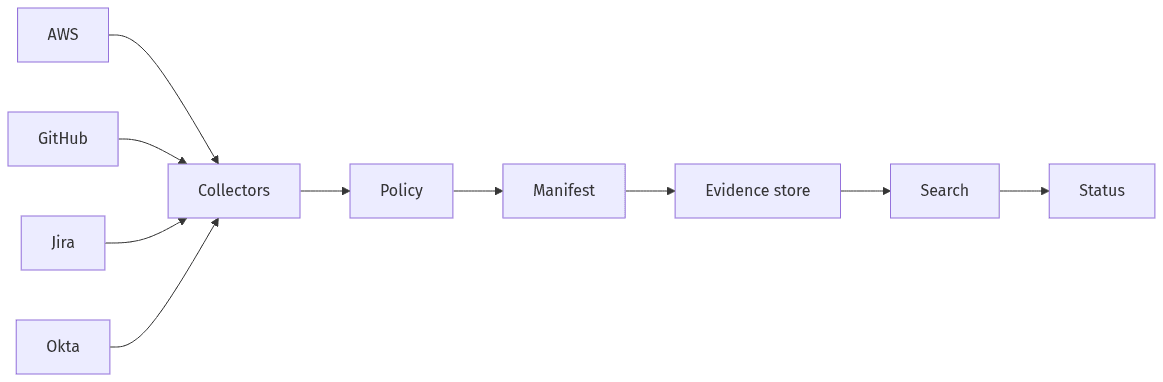 Evidence flows from core systems into a searchable store
Evidence collection programs in cloud-native SaaS environments tend to break down less from missing data than from weak organization and unclear lineage. A decision-ready architecture pattern generally includes collectors that pull from AWS, GitHub Actions, Jira, and Okta; an agent-orchestrated layer constrained by defined policy logic; and an evidence store designed for retrieval by control, system, and time window. Executive stakeholders typically focus on evidence freshness and completeness signals across the audit period, because audit evaluation centers on continuous operation rather than point-in-time snapshots.
Core building blocks and information flow
Common building blocks center on acquisition, normalization, retention, and visibility. Evidence manifests often become the organizing unit, tying each artifact to its source, timestamp, and control mapping. Chain-of-custody becomes a design property rather than a retrospective documentation task, which limits fieldwork debate about provenance and whether an artifact was modified.
Connecting common tools without overcomplicating
Integration complexity often grows from mismatched patterns across APIs, rate limits, and permission models. A consistent collection approach across AWS, GitHub, Jira, and Okta reduces operational rework because retrieval becomes predictable by system and control domain. In BOFU evaluations, integration coverage tends to matter more than long tool lists, since fragmentation is a common source of repeated audit interruptions.
Keep access narrowly scoped and auditor-ready
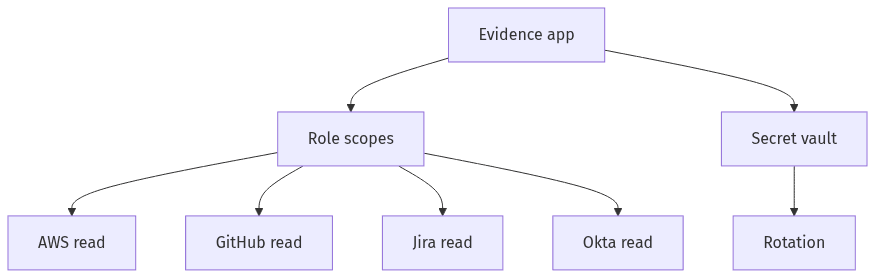 Least-privilege access separates data reads from secrets
SOC 2 automation introduces a security paradox: the same connectors that reduce audit effort can expand blast radius when permissions are vague or overly broad. Least-privilege access becomes a core architecture and procurement criterion because it affects production risk, separation of duties, and audit defensibility. Executive teams typically look for a permission posture aligned to “deny by default,” explicit scoping per system, and evidence that access governance is auditable rather than implied by vendor statements.
Read-only access where possible
Read-only permissions across AWS logs, GitHub repositories, Jira projects, and Okta reporting endpoints generally satisfy most evidence needs while limiting exposure. The misconception that automation requires admin tokens often creates avoidable risk and predictable friction with security teams. A narrowly scoped model also reduces audit confusion by making connector capabilities easy to explain and validate.
Rotate access and separate environments
Auditor-ready access governance commonly includes demonstrable credential hygiene and environment isolation, particularly between production and lower tiers. Rotation expectations and separation across environments often influence perceived program maturity, since they show the automation layer is subject to the same control principles it is documenting. This posture also limits the impact of connector compromise or misconfiguration.
Make evidence trustworthy and defensible
Evidence credibility rests on integrity and traceability, not volume. Audits often surface disputes when artifacts have unclear provenance, appear editable, or cannot be tied to an authoritative system record. Tamper-evident logging and immutable retention patterns address these issues by limiting silent alteration and preserving a consistent audit window aligned to Type II requirements. For SOC 2 evidence collection tooling, chain-of-custody is often what separates “centralized files” from audit-grade records.
Strong retention and tamper resistance
Retention expectations typically track the audit period and the organization’s recordkeeping posture, which increases the relevance of WORM or immutable storage patterns. Tamper resistance reduces reliance on individual operator discipline and shifts confidence toward the properties of the evidence system. This becomes most visible when audits scrutinize operating effectiveness and completeness over time.
Clear activity history for reviews
Activity history becomes a practical requirement when evidence needs to be explained months later during audit fieldwork. Hashing artifacts and maintaining a consistent manifest history supports defensibility by showing that retrieved items match what was originally collected. A complete history of sources and collection events also clarifies whether gaps reflect missing controls or missing telemetry.
Set guardrails and keep delivery fixed-scope
 Guardrails and scope limits keep automation predictable
Agentic AI introduces governance questions that traditional compliance tooling often sidesteps, particularly around autonomy and unintended side effects. Guardrails typically determine whether an evidence program reduces risk or adds it, since agent behavior can drift toward actions beyond collection when boundaries are implicit. Commercially, fixed-scope delivery complements guardrails: bounded integrations, defined control coverage, and explicit assumptions reduce surprise work and limit control sprawl that can erode timelines and audit readiness.
Limits and approvals for sensitive actions
A recurring executive concern is agents affecting production state, even indirectly, through overbroad permissions or ambiguous allowed actions. Governance commonly centers on explicit allowlists, approval gates for sensitive operations, and monitoring that makes deviations observable. Under this model, the “agentic” component remains focused on evidence orchestration rather than production mutation.
Simple fixed-scope packaging for delivery
Fixed-scope engagement models are often bounded by integration count, environments in scope, control coverage targets, retention requirements, and support windows during the audit period. This packaging aligns with BOFU decision drivers because it translates compliance intent into measurable deliverables such as evidence freshness windows, control-to-artifact mapping, and chain-of-custody properties. Pricing clarity also limits a common failure mode: open-ended integrations that do not converge.