
Alex Fesak
CEO
AI Agents for Fintech Customer Onboarding: A Secure Reference Architecture for KYC Data Collection, Risk Scoring, and Human-in-the-Loop Review
2026-05-26
Set onboarding goals and evidence expectations
AI agents for fintech customer onboarding tend to succeed or fail based on pre-agreed decision scope and evidentiary expectations, not model capability alone. In KYC/AML contexts, onboarding outcomes carry regulatory weight, increasing the importance of traceability, defensible decisions, and consistent treatment of edge cases. Executive alignment commonly centers on which decisions automation may influence, what evidence must be captured for each decision, and what residual risk is considered tolerable. Time-to-approve and operational efficiency often remain primary business goals, while operating alongside stricter requirements for PII privacy, auditability, and third-party exposure.
Scope, roles, and sensitive data handling
Clear boundaries around responsibilities often determine whether an agent workflow remains governable under audit. Ownership typically spans compliance, risk, security, and engineering, with sensitive data handling policies defining non-negotiable constraints. PII minimization becomes a central constraint, since broader data exposure increases leakage risk across prompts, logs, vendors, and downstream services.
Service targets and exceptions
Turnaround targets often shape automation design as directly as compliance expectations, because operational backlog pressure tends to concentrate in exceptions. Agreement on what qualifies as an exception, who owns the final decision, and what evidence must accompany escalations reduces interpretive drift. Escalation SLAs commonly become the mechanism that stabilizes customer experience while preserving compliance throughput.
Design a secure onboarding workflow
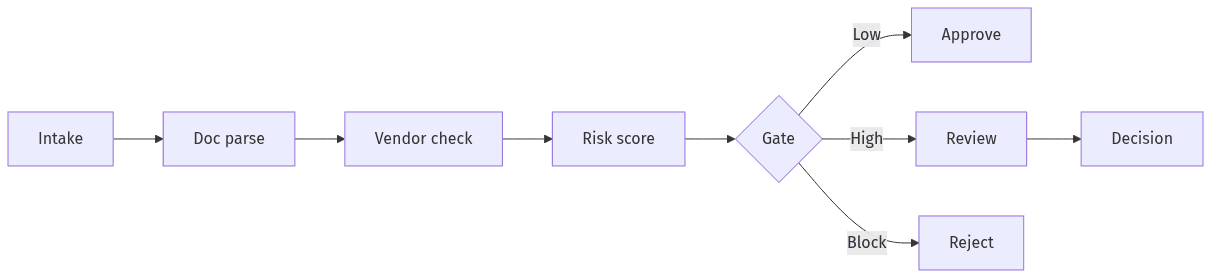 Secure flow with gates and human review
A secure onboarding workflow for agent-assisted KYC typically reflects explicit trust boundaries and controlled handoffs. A common pattern separates intake, verification, risk evaluation, and decisioning into distinct stages with constrained permissions, limiting lateral movement if a component fails. This structure matters because KYC agents routinely interact with untrusted inputs, including documents and free-text submissions, where prompt injection and data exfiltration risks concentrate. Security-first workflow design typically prioritizes containment, deterministic routing, and reviewability over autonomy, especially when outcomes affect approvals or enhanced due diligence.
Core flow from intake to decision
Reference architectures commonly describe a progression from data intake through document interpretation, vendor verification, and risk scoring, ending in approval, rejection, or escalation. Reliability tends to improve when system boundaries remain explicit, with narrow interfaces between stages. Predictable handoffs also strengthen audit trails by making responsibility and evidence easier to attribute.
Safety checkpoints and approvals
Safety checkpoints often function as policy-enforced gates that prevent an agent from expanding scope, accessing unauthorized data, or finalizing higher-impact outcomes without review. A deny-by-default stance aligns with least privilege and reduces blast radius during model drift or adversarial inputs. Approval moments also act as evidence anchors for audits and internal governance.
Protect customer data throughout KYC
 Minimize PII shared across stages and vendors
Customer onboarding concentrates sensitive identity data, and agent workflows increase the number of surfaces where exposure can occur. PII protection therefore becomes the primary safety lever, with architectural choices reflecting an assumption that prompts, context windows, and downstream logs can become accidental data stores. Privacy requirements such as GDPR and CCPA principles intensify the need for data minimization, purpose limitation, and retention discipline. The risk profile often hinges less on the presence of LLMs and more on where raw documents, extracted fields, and identifiers move across systems, vendors, and monitoring tools.
Minimize what’s shared and stored
Reducing shared and retained sensitive data typically lowers both compliance exposure and incident impact. Tokenized identifiers and selective field disclosure often replace broad document distribution, particularly when multiple vendors participate. “No raw docs in prompts” commonly appears as a governance stance because it limits inadvertent persistence in application logs and agent conversation history.
Control access to sensitive information
Access controls often determine whether privacy policies are enforceable rather than aspirational. RBAC and least privilege expectations become tighter in agent systems because tool access can function as delegated authority. Just-in-time access patterns often appear in mature programs, narrowing who can view sensitive attributes and for how long, while strengthening evidentiary defensibility.
Use vendors safely with consistent outcomes
Third-party KYC vendors often determine onboarding latency, customer experience, and compliance coverage, while also expanding the risk perimeter. Multi-vendor stacks create consistency challenges when results differ, inputs vary, or fallbacks trigger unexpected data sharing. From an executive perspective, vendor safety is not only a contractual issue but also an architectural one, since data disclosure, authentication scope, and routing logic influence overall control posture. The most material outcomes typically include consistent decision quality, bounded third-party exposure, and stable throughput under peak onboarding demand.
Consistent vendor results and routing
Consistency across vendors generally becomes a prerequisite for explainable decisions, particularly when risk scores or eligibility outcomes depend on external checks. Predictable routing reduces variability in spend and latency, while also simplifying audit narratives about why a given provider was used. Vendor inconsistency often appears operationally as exception backlogs and manual rework.
Limit third-party data exposure
Least-disclosure expectations typically increase when vendors receive identity documents or extracted attributes, since each transfer adds breach and retention concerns. Constrained vendor access, narrow payloads, and demonstrable disclosures align with regulator expectations for data governance. Executive scrutiny often concentrates on whether the organization can evidence necessity and proportionality for each shared element.
Make decisions reviewable and launch-ready
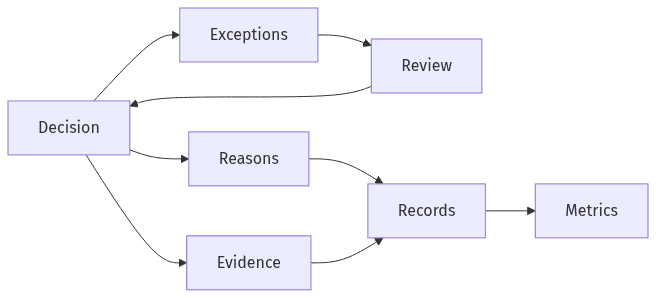 Reviewable decisions backed by records and metrics
Launch readiness in AI-assisted onboarding often depends on whether decisions remain reviewable under internal governance and external scrutiny. Reviewability links to explainability for risk scoring and to disciplined handling of exceptions, since automated outcomes without a defensible rationale can elevate compliance risk. Audit trails also need to function as evidentiary records rather than generic application telemetry, with retention and tamper-resistance expectations aligned to regulator inquiries. Performance tracking then connects business goals—time-to-approve, throughput, and reduced manual workload—to quality indicators such as error rates, reversals, and exception volumes.
Review-friendly decisions and exceptions
Decision narratives that pair outcomes with concrete reasons tend to reduce review time and limit policy ambiguity. Human-in-the-loop review becomes the primary control surface for edge cases, adverse signals, or conflicting vendor results, aligning accountability with compliance ownership. Escalation SLAs often provide the operational backbone that keeps exceptions from turning into sustained backlog.
Records, monitoring, and performance tracking
Regulator-ready records typically emphasize reproducibility, including what inputs were used, what tools were accessed, and what policy constraints applied at the time of a decision. Monitoring focuses on both security signals and decision-quality drift, since model behavior can change even when code does not. Performance tracking ties governance to outcomes through measurable throughput, review load, and reliability trends.