Field Services Dispatch Automation with AI: A Workflow Blueprint for Scheduling, Route Optimization, and After-Visit Summaries (Built on Your Existing Stack)
2026-05-03
Clarify the workflow goals before you automate
 Workflow goals with overrides and exceptions
AI field service dispatch automation tends to hold up when the underlying dispatch workflow already reflects operational constraints: SLAs, site access windows, variable job duration, parts readiness, and canceled or rescheduled visits. In construction and field services, day-to-day scheduling pressure often hides inconsistencies in triage, prioritization, and exception handling. A defined view of intake through after-visit documentation shifts automation from a “faster schedule” effort into an operations control layer, where routing, ETAs, and customer communication accuracy can be tracked as outcomes rather than treated as incidental effects.
Rules, exceptions, and human overrides
Dispatch automation often fails at the edges: emergency calls, incomplete job information, and competing SLA commitments. More durable approaches treat human-in-the-loop controls as a first-class requirement, with explicit override points and escalation paths. That posture avoids the “AI dispatcher replacement” framing and positions AI as decision support under operational governance.
Baseline success metrics
Operational leaders typically look for evidence in a small set of baseline measures: dispatcher hours spent scheduling and rescheduling, technician windshield time, SLA miss rates, failed visits, and rework tied to incomplete documentation. Without a pre-automation baseline, changes in routing, ETA reliability, and after-visit reporting blend together and weaken ROI credibility under CIO, CTO, and executive cost scrutiny.
Get the essential job and technician information in place
Scheduling, route optimization, and after-visit summaries depend on consistent job and technician data, not tooling alone. Construction and field service environments amplify small data defects: an incorrect address creates cascading ETA noise; missing skills data drives misassignment; weak duration estimates increase double-booking risk. The “workflow blueprint” reality is that intake, triage, dispatch, and reporting share the same core record, making data quality a structural dependency for automation rather than a downstream cleanup effort.
Minimum information needed
The minimum viable dataset typically centers on job location accuracy, time windows, priority and SLA commitments, contact details, parts or prerequisite readiness, and technician availability with skills and certifications. These fields determine feasibility in assignment logic and reduce the chance that routing optimization produces schedules that appear efficient but fail against on-site constraints.
Keep information clean and reliable
Duplicate customers, inconsistent job codes, and fragmented technician profiles often surface as “automation errors,” even when the automation logic is behaving as designed. Reliability improves when the job record remains coherent across dispatch updates, technician notes, and after-visit documentation. That coherence also supports auditability, particularly where least-privilege access and activity logging factor into compliance and internal controls.
Connect the systems you already use
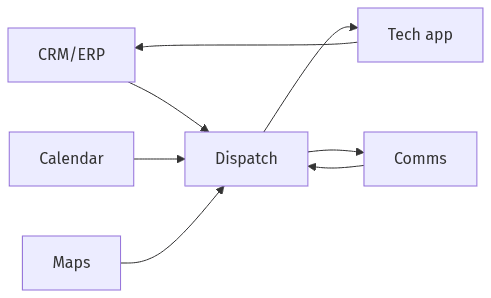 Existing stack sync for schedules and ETAs
Field service operations often run a patchwork of CRM/ERP platforms, calendars, mapping tools, and communications channels, with ServiceTitan, Salesforce Field Service, Dynamics 365 Field Service, or NetSuite commonly acting as the hub. Dispatch automation value frequently comes from cross-system consistency rather than new interfaces: a schedule change reflected in the system of record, calendar availability that matches actual capacity, routing that incorporates traffic-aware constraints, and customer updates aligned to the current plan. Integration feasibility and API limits tend to become executive concerns when scaling beyond a pilot.
Where updates should live
Conflicting sources of truth routinely cause double-booking and status confusion, particularly when dispatch boards, technician apps, and calendars maintain overlapping versions of the same job. A clear ownership model for job status and notes reduces synchronization conflicts and makes after-visit summaries more consistent, since summarization quality depends on stable inputs rather than shifting fields.
Customer updates and ETAs
ETA accuracy often functions as a proxy for operational maturity because it reflects routing realism, schedule stability, and timely recognition of exceptions. Customer communication improves when arrival windows and schedule changes remain aligned across notifications, CRM records, and dispatcher views. Weak ETA governance can increase complaints and reschedules, undercutting the productivity case that routing optimization is intended to support.
Automate scheduling and replanning as conditions change
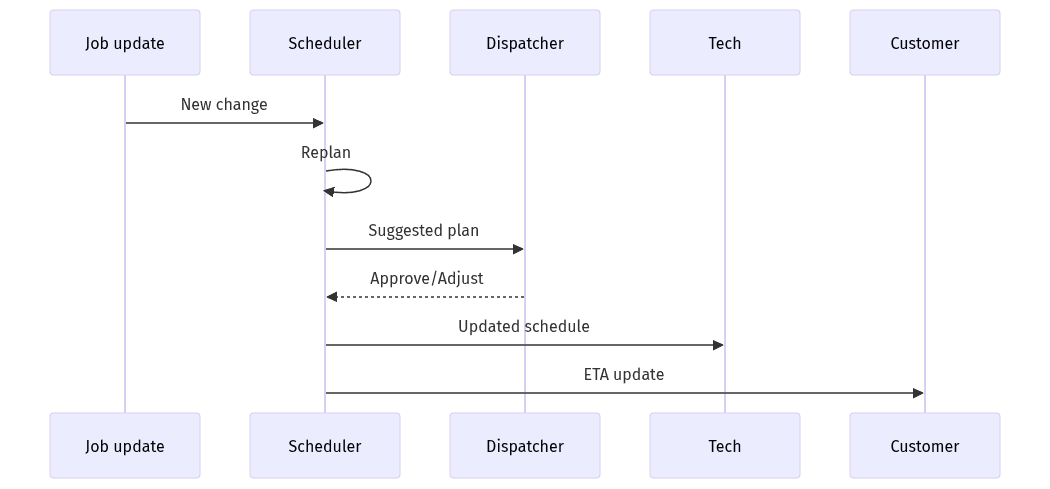 Replanning loop with approvals for urgent changes
In field services, schedules rarely remain valid for long; cancellations, weather, parts delays, and emergency calls turn “daily plans” into a rolling negotiation between SLAs and capacity. Automation creates value when it continuously reflects constraints—skills, travel time, time windows, and service commitments—without producing brittle outputs. Replanning capability matters as much as the initial schedule because execution reality, not optimization theory, drives windshield hours, first-time fix rates, and overtime exposure.
Match work to the right technician
Skills-based assignment typically sits alongside capacity and proximity constraints, especially when specialized certifications and safety requirements determine who can enter a site. Travel-time realism often influences utilization more than nominal route “efficiency,” since traffic variation and clustered work zones can reshape the day. Dispatch gains commonly show up as fewer manual reshuffles and fewer SLA-driven escalations.
Handle emergencies and disruptions
Emergency insertion typically creates the highest operational stress because it forces tradeoffs across downstream jobs and customer expectations. More credible automation patterns treat disruption as normal and evaluate the cost of delay, SLA penalties, and customer impact. Human approvals remain central in high-stakes changes, supporting accountability and reducing the risk of automation decisions that appear optimal but lead to service failures.
Roll out in 6–10 weeks and prove value
A 6–10 week rollout is often treated as a test of scope discipline rather than engineering speed, because scheduling, routing, and after-visit summaries touch multiple systems and stakeholder groups. A pragmatic blueprint typically sequences early value around dispatch time reduction and ETA reliability, then extends into richer routing constraints and more standardized documentation. Credibility with executives tends to rest on measurable outcomes, stable integrations on the existing stack, and controls that keep automation explainable and auditable as usage expands.
Phased delivery plan
Phased delivery commonly appears as a progression from workflow discovery into a contained pilot and then broader rollout, with milestones expressed as observable operational capabilities rather than technical components. A single-region pilot pattern often holds up because it limits variation while surfacing exception behavior that a broader launch would amplify.
ROI and ongoing measurement
ROI narratives in dispatch automation typically anchor on dispatcher time saved, windshield hours reduced, SLA improvement, and lower rework tied to consistent after-visit summaries. Ongoing measurement acts as a governance mechanism, not merely reporting, because it surfaces where data quality, exception patterns, or integration drift erode performance. Executive confidence tends to rise when value remains attributable to specific operational KPIs rather than generalized “AI productivity.”