Replatforming WordPress to Headless for eCommerce Content + SEO: Architecture, Cost Model, and Rollout Plan
2026-04-26
Decide if headless fits your eCommerce content and SEO goals
Headless replatforming with WordPress in an ecommerce stack tends to work when the business case is tied to measurable operating and search outcomes rather than architectural preference. Brands on Shopify or BigCommerce often use WordPress as the primary channel for SEO-led content, and the headless discussion typically starts under pressure from performance constraints, frontend iteration needs, or multi-market content requirements. The shift also creates additional operational surface area—separate deployment cycles, clearer ownership boundaries, and higher expectations for governance. Executive alignment tends to matter most here because the largest risks are usually discovered later as avoidable friction in SEO control, preview reliability, and ongoing run costs.
When headless is worth it
Headless tends to justify itself when content-led acquisition depends on both strong Core Web Vitals and tight coupling to commerce data, without pushing WordPress into storefront responsibilities. Benefits typically show up as cleaner separation between editorial and transactional concerns, paired with steadier frontend performance under load. Tradeoffs usually include more coordination across hosting, monitoring, and release management.
Define success criteria upfront
Success definitions usually narrow to three categories: organic search stability, publishing throughput, and performance thresholds aligned to Google’s Core Web Vitals. Launch gates often translate into acceptable ranking variance, crawl error tolerance, and page experience targets such as LCP, INP, and CLS. The most durable criteria also specify post-launch ownership for SEO-relevant changes and an explicit release cadence for fixes and enhancements.
Set the new site setup at a high level
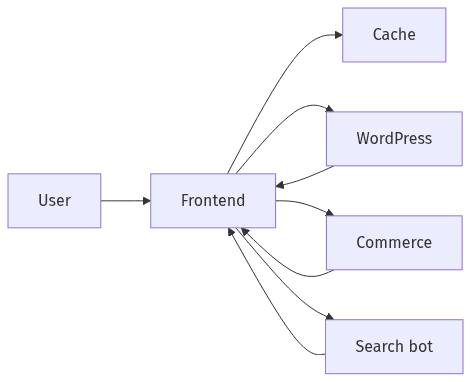 High-level headless setup for content and commerce
A headless model changes the operating model as much as the technology stack, so early agreement on “what lives where” helps prevent predictable friction later. In a typical Shopify or BigCommerce pairing, the commerce platform remains the system of record for products and checkout, while WordPress supports editorial content, landing pages, and brand storytelling. Tension often arises when URL patterns, metadata, and templates are split across systems without a clear control plane. High-level architecture choices—content delivery APIs, rendering approach, and caching posture—also affect indexability and Core Web Vitals consistency.
What WordPress vs commerce platform owns
Ownership boundaries usually cover page types, URLs, metadata, and template logic. Split ownership can create “double authority” conditions, particularly when Shopify/BigCommerce and WordPress can both publish overlapping content types. Governance at the executive level often centers on a single source of truth for URLs and SEO metadata to limit duplication and mixed indexing signals.
Page delivery choices that influence SEO
Rendering decisions often distinguish high-intent commercial pages from editorial content, and hybrid patterns appear in many implementations. SEO behavior typically reflects whether pages remain reliably crawlable and performant under real traffic conditions. Core Web Vitals outcomes are frequently driven more by caching strategy, image delivery, and third-party script control than by the “headless” label.
Protect SEO during migration
 SEO control points during replatforming
SEO exposure is most visible during migration because search engines treat URL changes, redirects, and indexing signals as trust cues that can affect traffic and revenue. Headless migrations often combine content movement with changes to routing, templates, and sometimes domain or subfolder strategy. Those simultaneous changes can introduce 404s, redirect chains, and inconsistent canonical behavior when governance is not explicit. More stable outcomes tend to align with enforced URL rules, a single accountable owner for redirects, and verification of indexation signals across core page types before and after cutover.
URLs and redirects
URL inventories and redirect coverage often determine whether link equity and historical rankings carry over without avoidable loss. Risk increases when multiple teams can change slugs, routes, or rewrite rules without a shared register. Correct HTTP status codes and avoiding redirect chains typically matter as much as maintaining a redirect spreadsheet.
Indexing signals and duplication risks
Canonical tags, XML sitemaps, and robots directives function as the control plane for headless indexation, especially when content is distributed across WordPress and Shopify/BigCommerce. Duplication commonly appears when category-like pages, campaign hubs, and long-form descriptions overlap across systems. Search stability typically improves when canonicals and sitemaps express one consistent source of truth.
Keep publishing simple for marketers
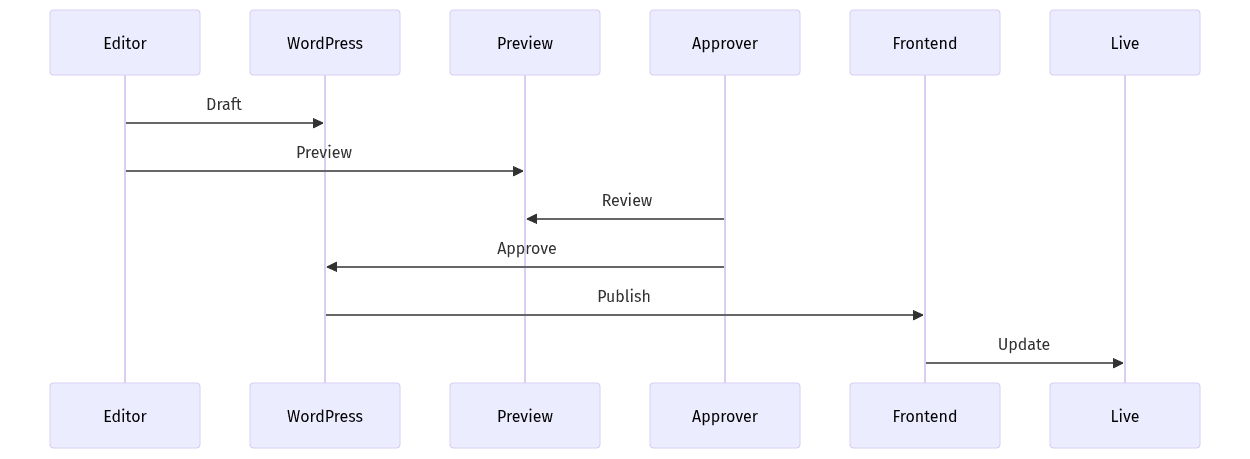 Preview and publish flow with clear responsibilities
Editorial velocity often becomes the hidden KPI in headless programs because workflow friction can offset gains from faster page delivery. WordPress remains familiar for drafts, scheduling, and approvals, but headless delivery creates distance between what editors see in the CMS and what users see in production. Preview reliability can become an executive-level issue when campaign timelines depend on it. The most resilient setups treat preview security, environment parity, and rollback ownership as product requirements rather than implementation details.
Previews that reflect the live site
Preview gaps are frequently the first day-to-day issue after a headless change, especially when staging differs from production in caching behavior or third-party scripts. Confidence tends to depend on close parity between preview rendering and live rendering, with access controlled through protected preview links. Parity failures often surface as missed QA, late fixes, and delayed publishing.
Approvals and release responsibilities
Approval flows in headless setups often reveal ambiguous ownership between content correctness and technical correctness. Marketing teams may treat WordPress publish actions as final, while engineering controls deployments that can change rendering behavior and SEO tags. Clear responsibility boundaries, often expressed as a RACI, tend to reduce launch escalations and limit post-launch SEO drift.
Plan costs and a phased rollout
Headless economics rarely resemble a one-time rebuild because operating costs spread across the CMS, frontend runtime, integrations, and observability. Budget variance often comes from preview environments, monitoring, CDN and image delivery, and ongoing maintenance for APIs and rendering layers. Timeline assumptions also change because SEO validation and parity testing become gating work, not end-stage cleanup. A phased rollout typically reduces risk by limiting blast radius, preserving rollback options, and giving organic signals and Core Web Vitals time to settle between releases.
Ongoing costs to expect
Cost models usually separate one-time delivery from run-rate ownership across hosting, tooling, monitoring, and staffing. Headless programs often add spend for CDN and image delivery, preview infrastructure, and ongoing frontend maintenance alongside the WordPress run costs that remain. Total cost of ownership tends to depend less on initial build scope than on release frequency and governance discipline.
Phased release plan with checkpoints
Phased releases typically follow risk segmentation: lower-impact content sections first, then higher-impact templates and routing, with validation checkpoints between milestones. Rollback posture matters most for SEO-dependent brands because organic volatility can be financially material. Post-launch validation generally centers on crawl errors, indexation alignment, and Core Web Vitals visibility via real-user measurement.