
Alex Fesak
CEO
Composable Checkout for US eCommerce: Microservices Reference Architecture for Tax, Promotions, Payments, and OMS Sync (Without Breaking Conversion)
2026-05-20
Start with checkout goals, speed targets, and risk tolerance
Composable checkout programs in US eCommerce tend to hold up when speed and reliability targets are treated as explicit product requirements rather than side effects of architecture. Checkout latency is tightly coupled to conversion sensitivity, so additional network hops across tax, promotions, fraud, and payment calls quickly become commercial risk. Risk tolerance defines what constitutes unacceptable outcomes, especially around duplicate charges, duplicate orders, and inconsistent state between payment authorization and order creation. These goals set the decision context for orchestration behavior, retry strategy, and what belongs on the critical path.
Critical checkout steps and ownership
Checkout performance and correctness typically depend less on any single service than on clarity around which steps are “must-not-fail” and which teams own their outcomes. Tax, promotion pricing, fraud signals, payment authorization, and order creation often span different owners and vendors, while the customer experiences one continuous flow. A recurring pattern in peak periods is that unclear ownership leads to conflicting SLAs, fragmented observability, and slower incident resolution.
Define clear checkout components and responsibilities
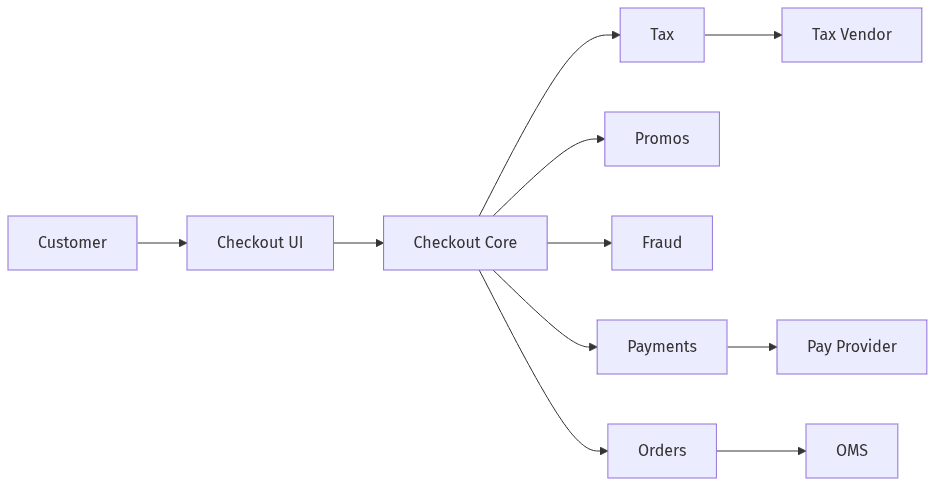 Clear checkout components and key integrations
Microservices checkout modernization often stalls when boundaries mirror org charts rather than checkout decisions and state transitions. Clear responsibilities limit surprise coupling, especially when promotions affect taxable amounts, fraud decisions influence payment routing, and OMS requirements constrain order fields. An orchestration layer usually becomes the place where cross-service contracts are made explicit, including sequencing, timeouts, and state transitions. Without explicit contracts, distributed transactions drift into implied behavior, where partial failures are difficult to reason about and difficult to reconcile for finance and operations stakeholders.
Key areas: tax, promotions, fraud, payments, and orders
Tax, promotions, fraud, payments, and order services generally represent distinct decision domains with different compliance and risk profiles. US tax calculation integrations such as Avalara or Vertex add external latency and edge-case behavior, while promotion rules create pricing ambiguity and reconciliation exposure. Payment authorization and capture add fraud exposure and PCI scope sensitivity, and order creation introduces OMS dependencies that define what “checkout complete” means operationally.
Consistent connections between systems
Checkout microservices become fragile when integrations use inconsistent request semantics, identifiers, and error interpretation. Consistent identifiers, contract versioning discipline, and service-to-service authentication help limit long-term behavioral drift. Observability becomes a governance concern as well, since distributed tracing and shared correlation IDs often determine whether conversion-impacting incidents are diagnosable quickly or persist through multiple escalations.
Keep checkout fast by reducing waiting and unnecessary calls
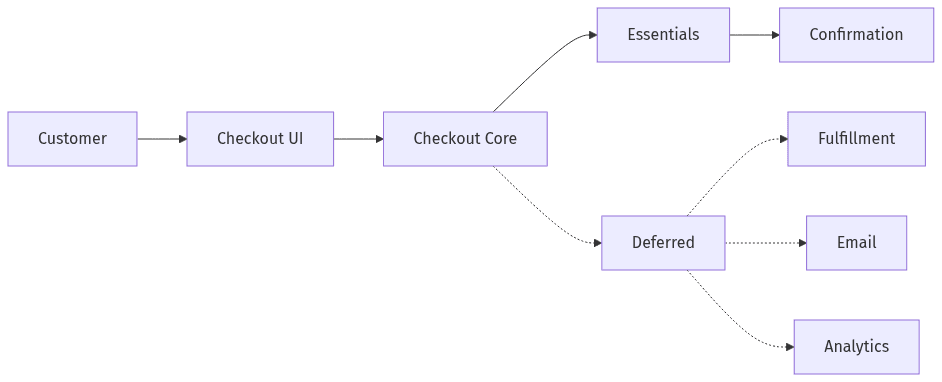 Short critical path with deferred work
Composable checkout can increase development flexibility while quietly increasing latency unless waiting time is treated as a hard constraint. The checkout path has limited tolerance for synchronous dependencies, particularly where external vendors introduce variable response times and throttling. Parallelization and caching commonly surface because tax quotes, promotion evaluation, and risk scoring otherwise serialize into a single slow chain. Performance work here is primarily about protecting p95 latency, preventing cascading timeouts, and avoiding conversion volatility under peak load.
What to do during checkout vs after
A stable composable checkout usually maintains a narrow critical path where only essential, customer-visible decisions are synchronous. Non-essential activities are often deferred to asynchronous processing to reduce blocking and to isolate failures that do not need to interrupt purchase completion. This separation also shapes the reliability posture, since deferred work depends on deterministic state models and durable events rather than browser-bound execution.
Prevent duplicates and handle retries safely
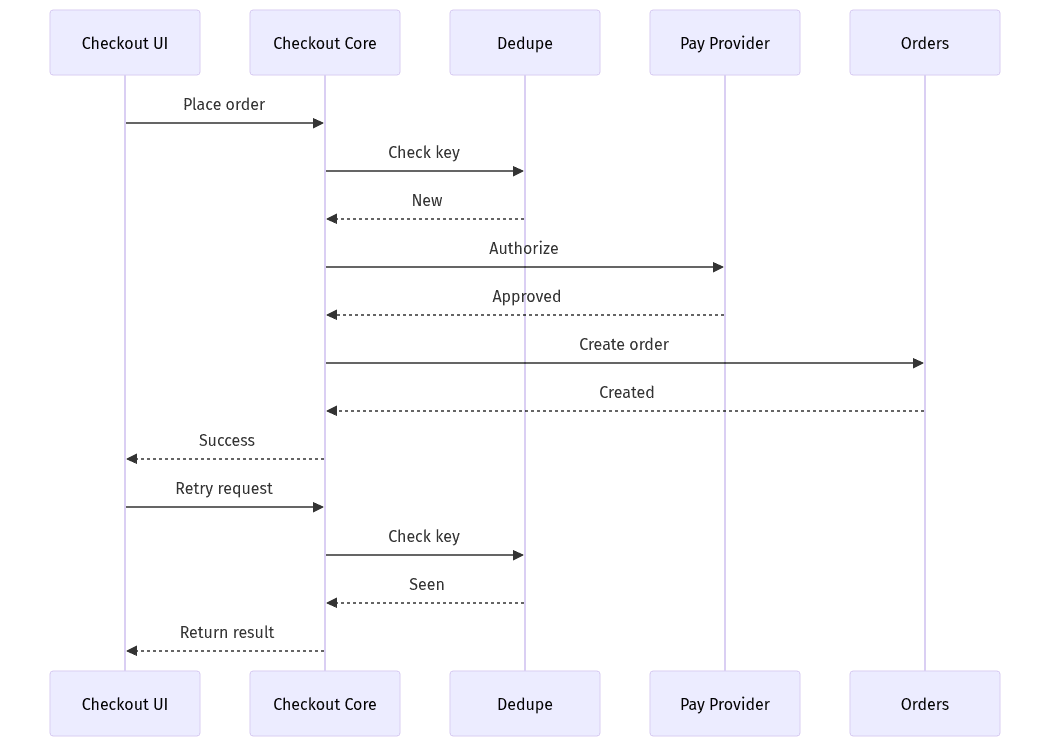 Retry flow that avoids duplicate charges
Retries and timeouts become a dominant failure mode once checkout decomposes into services, because repeated requests can create repeated side effects. Duplicate charges and duplicate orders commonly originate from mismatched assumptions: callers infer an operation did not happen, while downstream systems processed it but responded late or failed to respond. Exactly-once delivery is frequently assumed yet rarely achievable across vendor APIs, message buses, and network boundaries. Idempotency keys, request deduplication, and a durable record of side effects become central to payment and order correctness.
Rules for safe retries
Retry behavior typically needs consistent semantics across the orchestration layer, internal services, and vendors, since mismatched timeouts can trigger retry storms. Vendor idempotency is not uniform, so internal systems often carry the responsibility for preventing repeated authorizations or repeated order-creation calls. Fast-fail handling for non-retriable errors and disciplined treatment of ambiguous outcomes tend to matter as much as the retry mechanism itself.
Integrate vendors and roll out changes with confidence
Vendor integrations and migration rollouts often determine whether composable checkout becomes manageable change or a prolonged risk surface. Tax providers such as Avalara or Vertex, fraud platforms, payment processors, and OMS APIs each impose constraints around timeouts, throttling, and idempotency behavior. Migration risk also includes analytics discontinuities, because headless and composable flows can separate browser events from server-side events in ways that distort attribution. Confidence is usually tied to phased change patterns and measurable guardrails around conversion, error rates, duplicate rates, and tracking fidelity.
Order system sync and payment-to-order gaps
Payment authorization and OMS order creation often produce mismatched outcomes, particularly when one side succeeds and the other encounters a timeout or validation failure. These gaps create customer-facing issues and add reconciliation overhead for back-office teams, increasing chargeback and support exposure. Saga and compensation concepts typically surface here, especially when rolling back promotions or tax calculations and reconciling authorized payments that do not have corresponding orders.
Analytics continuity across checkout changes
Analytics often degrades during composable checkout migrations because identifiers, event timing, and consent handling shift across client and server boundaries. Attribution drift becomes a finance constraint when marketing spend depends on consistent signals, and it becomes a product constraint when funnel diagnostics lose comparability. Stable correlation IDs, consistent event definitions, and monitoring for tracking gaps typically become as important as monitoring latency and error rates.