Alex Fesak
CEO
Top-Grade WordPress for Enterprise: Architecture That Actually Scales
2026-01-02
WordPress often carries a poor reputation in enterprise environments. It is commonly associated with performance limitations, security concerns, and excessive reliance on plugins.
In many cases, these perceptions are understandable—but they are rarely caused by WordPress itself. They are the result of architectural decisions. This article explains how enterprise organizations successfully use WordPress as a stable, secure, and scalable platform, and why the difference lies not in WordPress itself, but in the architectural choices and implementation practices around it.
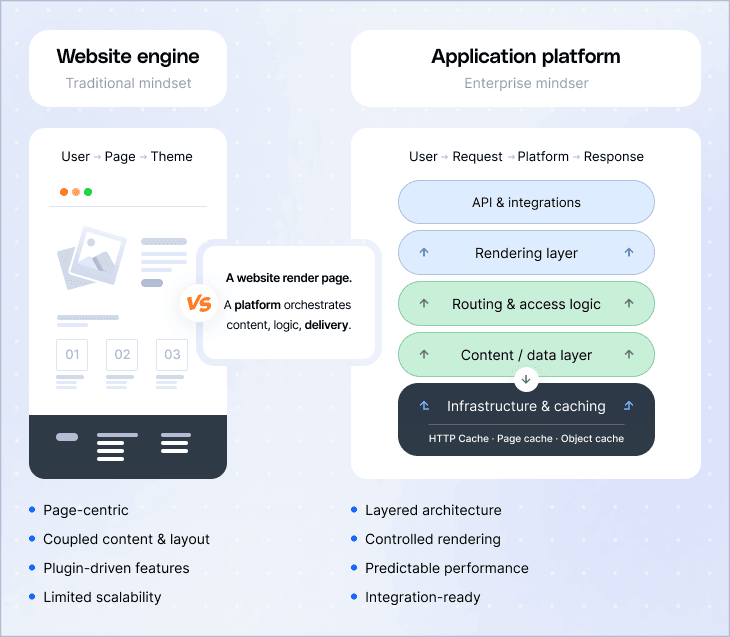
WordPress Is Not a Website Engine — It Is an Application Platform
In mature implementations, WordPress is no longer treated as a theme-driven website. It operates as an application core responsible for three fundamental layers:
- Content — structured, predictable data rather than ungoverned HTML,
- Routing — controlled logic that defines how content is accessed and presented,
- API layer — a reliable source of data for integrations, automation, and internal systems.
The key distinction is this: enterprise WordPress is not a debate about headless versus non-headless architectures. It is about control, clear boundaries, and architectural discipline.
Three Enterprise-Ready WordPress Architectures
1. Classic Headless WordPress
In a classic headless architecture, WordPress is used strictly as a content management system. It stores structured content and exposes it through APIs (REST or GraphQL), while all routing, rendering, and user experience are handled by a separate frontend application—typically built with React, Next.js, or a comparable framework.
This approach presupposes that:
- one backend must serve multiple clients such as web, mobile, or other digital channels,
- the frontend requires full architectural freedom independent of CMS constraints,
- WordPress is only one component within a broader digital product ecosystem.
However, for many enterprise marketing and B2B platforms, a fully headless setup introduces unnecessary complexity. Maintaining two independent technology stacks increases operational overhead and raises the total cost of ownership.
Headless WordPress is a powerful architectural option—but it is a deliberate choice, not the default enterprise answer.
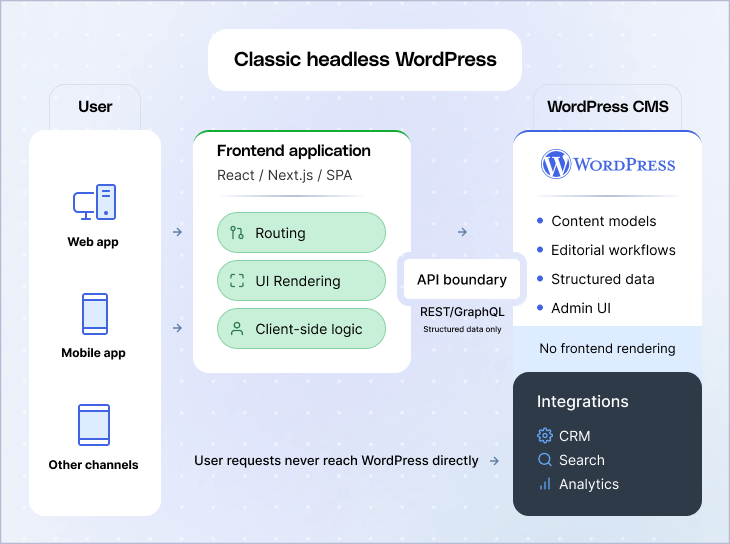
In a classic headless setup, WordPress acts purely as a content and data backend. All routing, rendering, and user experience are handled by a separate frontend application.
2. Hybrid / Decoupled WordPress (the enterprise sweet spot in ~70% of cases)
This is the most effective architecture for the majority of enterprise websites. In a hybrid setup, WordPress:
- renders HTML for public-facing, SEO-critical pages, enabling fast time-to-market,
- acts as an API provider for integrations, calculators, automation, and internal tools,
- retains strict control over routing and presentation logic.
This model combines:
- WordPress’s native SEO strengths,
- predictable performance and scalability,
- selective decoupling only where it delivers clear business value.
The advantage is straightforward: lower risk, reduced complexity, and stronger long-term predictability.
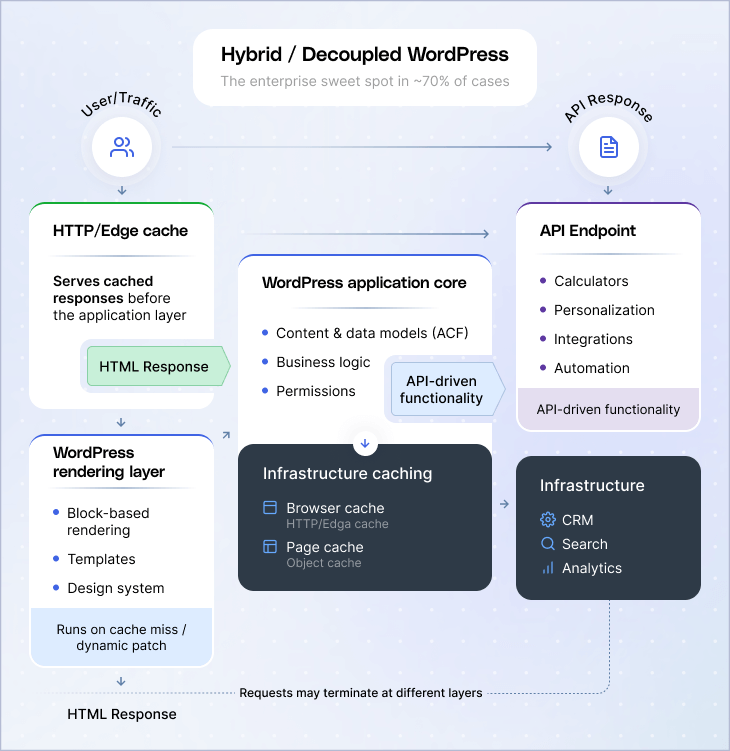
Hybrid WordPress combines server-side rendering and API-driven functionality in a single platform, delivering flexibility without unnecessary architectural complexity.
3. Monolith — With Application Discipline
WordPress can be enterprise-ready even without a headless or hybrid architecture—when it is designed as an application rather than a theme playground. This approach is defined by:
- strict separation of data, business logic, and presentation,
- no page builders,
- a minimal, purpose-driven plugin set,
- controlled rendering instead of ad-hoc output.
While this model may appear monolithic, it behaves like a managed system: stable, performant, and predictable over time.
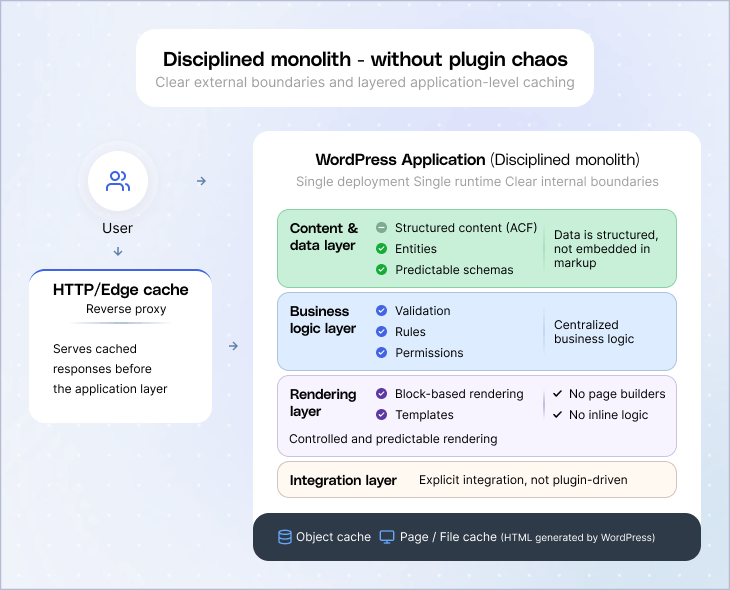
A disciplined WordPress monolith delivers stability and performance through clear internal boundaries, not architectural fragmentation.
Block-Based Architecture Without Page Builders: The Foundation of Stability
Page builders are the primary reason WordPress fails at scale. They introduce:
- excessive DOM output,
- uncontrolled JavaScript execution,
- progressive performance degradation with every new page.
Enterprise WordPress replaces page builders with a block-based architecture built on:
- Gutenberg and custom blocks,
- a clearly defined design system,
- constrained but intentional editorial freedom.
The result is not reduced flexibility, but controlled flexibility—the exact balance required by enterprise systems to remain stable, performant, and maintainable over time.
ACF as a Data Layer, Not a “Fields Plugin”
In enterprise-grade WordPress architectures, ACF is not treated as a convenience tool for editors. It functions as a structured data layer that defines how content is modeled, stored, and consumed. This approach enables:
- predictable rendering,
- efficient and reliable caching strategies,
- clean, integration-ready data structures.
When content is treated as data rather than markup, WordPress becomes resilient instead of fragile.
Multi-Layer Caching: Why One Plugin Is Not Enough
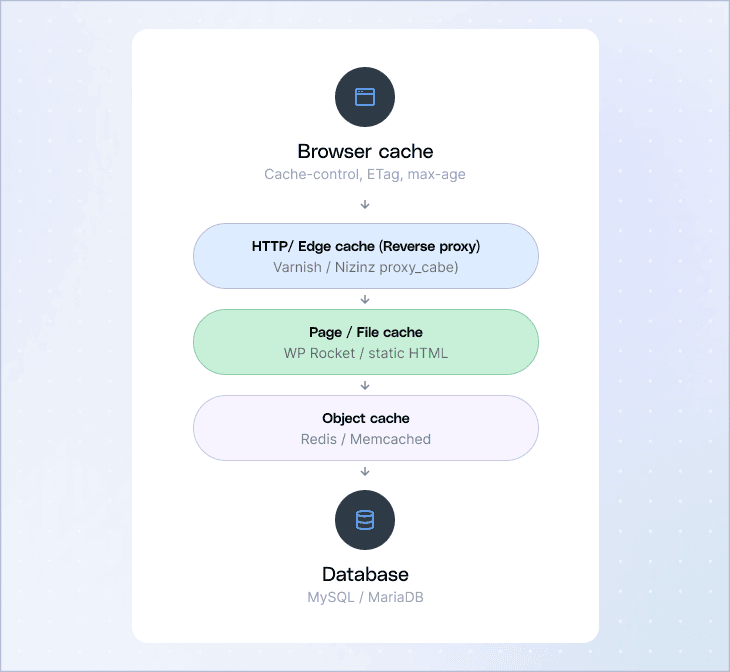
Enterprise WordPress performance is achieved by ensuring that the majority of user requests are handled before they reach the application layer.
A proper setup typically includes:
- Browser caching — explicitly defined cache lifetimes for static assets to reduce repeat requests and improve perceived performance,
- HTTP or edge caching — serving fully rendered responses before the application layer is invoked, minimizing latency and absorbing traffic spikes,
- File or page caching — delivering pre-rendered HTML generated by WordPress, bypassing most application logic and database queries on repeat requests,
- Object caching — caching query results, structured application data, and computed logic in memory to significantly reduce database load and execution overhead.
The result is performance comparable to custom-built platforms, achieved through architectural discipline rather than increased operational complexity.
Supporting optimizations such as CDN-based asset delivery and lazy loading further improve user experience and global latency. However, these techniques are complementary: enterprise performance is driven primarily by layered caching and request handling strategies, not front-end optimizations alone.
Security Without Constant Firefighting
WordPress becomes a security liability when it is treated as a constantly patched system rather than a governed application.
Excessive plugins, loosely defined permissions, and direct production changes inevitably lead to reactive security management and ongoing firefighting.
An enterprise security approach shifts the focus from reacting to incidents to preventing them through architecture and governance. In practice, this means:
- reducing the attack surface through a minimal, purpose-driven plugin set and clearly defined system boundaries,
- strict separation of environments (development, staging, production) to ensure that changes are tested and validated before reaching users,
- controlled deployment and update workflows, eliminating ad-hoc fixes and direct production modifications,
- principle-based access control, where permissions are limited, auditable, and aligned with defined roles rather than convenience,
- predictable and observable system behavior, enabling monitoring, auditing, and compliance without operational friction.
In this model, security is not enforced by piling on defensive plugins. It emerges naturally from a system that is intentionally designed, tightly controlled, and operationally predictable.
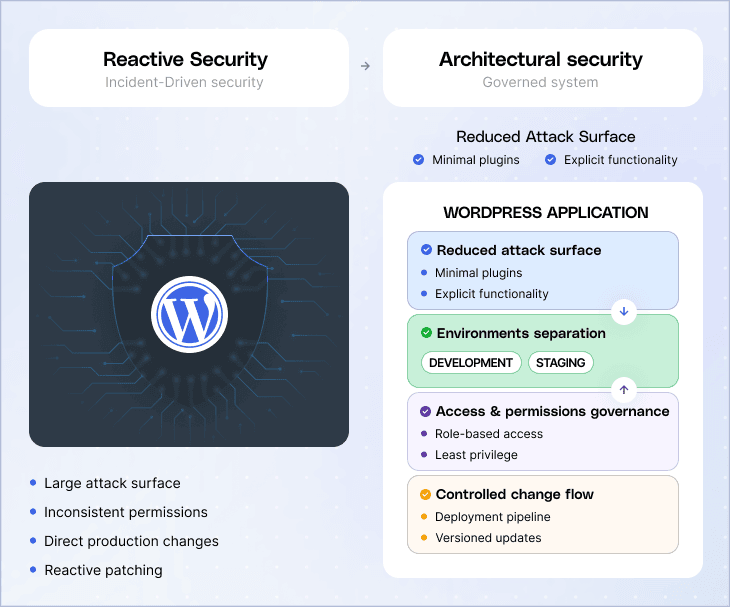
Architectural security replaces reactive patching with controlled change, clear boundaries, and reduced attack surface.
When WordPress Is the Right Enterprise Choice — and When It Is Not
WordPress excels in environments where flexibility, content velocity, and integration capability are strategic advantages. It is particularly well suited for:
- content-driven acquisition platforms,
- B2B marketing and growth systems,
- fintech and mortgage websites with complex integrations,
- use cases where SEO and speed of iteration are critical.
However, WordPress is not designed for:
- ultra-low-latency trading systems,
- core transactional engines with strict real-time constraints.
Being explicit about these boundaries is a hallmark of a mature engineering strategy.
Conclusion
WordPress becomes problematic only when it is treated as a shortcut. When it is architected and implemented as an enterprise application—with discipline, clear constraints, and a coherent architectural vision—the common issues disappear. Enterprise WordPress is not a compromise. It is an engineering decision.
At EcDev Studio, we design WordPress as an enterprise platform—not as a page-builder playground. If you are evaluating WordPress for a serious, long-term product, architecture matters far more than the CMS label.